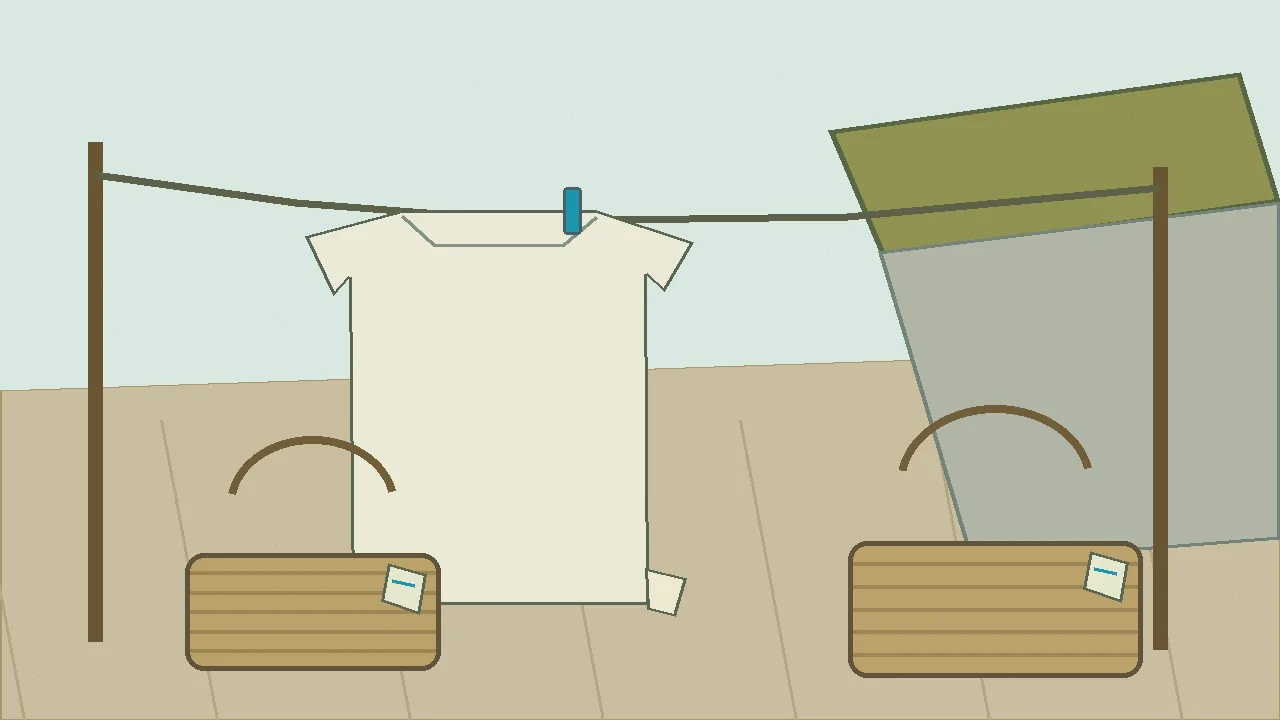
One shirt hangs just outside the covered part of the yard. The blue pin keeps a tag beside its cuff. A cloud moves into view and the laundry keeper decides to move the shirt under the awning. The shirt will use a new position and a different part of the line. If the old drawing stops being visible, the player still needs something that tells them which garment moved. A pin and a tag can do that work if they travel together.
The test belongs to A Line Before the Rain. We start with one square drawing of an exposed rail, and another where the same shirt appears under the awning. The roof itself is a useful landmark. It does not explain which shirt goes back to which return bundle. The smaller mark needs a place of its own in the picture.
Draw the pin beside something that stays on the garment
In a previous version, the tag hung on the rail next to the garment. Removing the garment left the tag in view. It was easy to identify the original location and harder to tell whether it still applied to the right shirt. We moved the tag to the same cuff in both views. The rail’s position mark remains visible as a separate clue. It identifies where a pin could sit, rather than marking an item whose location may change.
The two tags have different corners and short written labels. A plain blue band can suggest which one is selected, but a reader also needs its shape and position. One drawing shows it from the table end, another from the side of the covered rail. The angle changes while the relative position of the tag and cuff stays the same.
Keep the empty place useful
Once the shirt moves away, its original pin position is empty. An early drawing removed the mark for the pin as well as the shirt. It was difficult to tell whether the two views showed the same part of the line. Keeping the empty mark helps the player say where the shirt was. The narrow cap on the other rail can then show where it is now. The player can compare a before and after view without relying on memory alone.
Try a move when a darker garment already occupies the closest covered pin. A reader should still recognize the shirt farther along the rail. If the tag is obscured, show a short description below the picture and make sure it points to the right visible shape. You can test the wider cloth next without adding more labels to the empty space.
Let the handover be the last place to read
After moving the shirt, the keeper takes it off the line and puts it at the return table. The tag stays beside the folded bundle. A matching mark on the return slip can tell the user which order it belongs to without repeating the outline of the shirt. That is a more useful check than assuming the last item moved is the one the visitor arrived to collect.
The Button in the Pocket uses a similar tag on a tray. There the object can remain in a different place from the coat. The tag still needs to connect the two before the order is returned. Open both from the basket shelves and compare the place of the visible mark. One is attached to a garment. The other stays with something found inside it. Those should be two distinct places in the drawing even when the same return mark appears on both. An extra move at the end of the level is useful only if the visual record still lets a reader make that distinction.